If you run a restaurant or takeaway in Belfast, you already know the shift: more digital orders, tighter staffing, and margins that do not forgive waste. Industry data puts average full-service restaurant net margins around 10.5% — before anyone argues about the tech bill. When payment processing is the largest variable cost in many venues, small percentages stop feeling small.
This article summarises what UK operators are typically paying to run modern EPOS — software, hardware, and card fees — and why teams look for setups that do not tax every order twice.
The SaaS layer: “cheap” software often isn’t the full bill
Many hospitality POS products are sold as monthly subscriptions. Entry tiers can start at £0/month (freemium) or £49–£69/month for fuller restaurant kits, while mid-market and enterprise stacks often land in the £129–£219/month range for advanced tiers — before you add modules like kitchen display (KDS), which some vendors price as separate monthly add-ons (commonly £15–£19+ per module).
In parallel, some legacy bundles still push long-term contracts and subsidised hardware — which can look attractive on day one and expensive on exit.
Takeaway: even when the POS app looks affordable, licence + modules + extra tills can scale faster than a small team expects.
Card-present fees: the line that dwarfs the monthly invoice
For busy venues, per-transaction payment fees usually matter more than the monthly software line. Widely quoted UK blended in-person card rates for major SME POS ecosystems are typically in the ~1.69%–1.75% range for standard pay-as-you-go tiers — and online / card-not-present flows can be higher still, sometimes with fixed pence per authorisation that hurt low-ticket orders.
At volume, those differences are not academic. Research on break-even thresholds suggests that once card throughput passes modest monthly levels, moving from a “free software / higher rate” mix to a “subscription + lower rate” mix can change total cost — which is exactly why operators are told to model total cost of ownership, not just the headline monthly fee.
Takeaway: if you are high-volume, optimising the processing rate often beats optimising the POS logo.
Hardware: the cost that marketing forgets to include
Tablet-led systems can look sleek until you price the iPad, stands, printers, and peripherals. All-in-one terminals and branded kits frequently run from hundreds to £999+ for complete bundles — and KDS screens can add hundreds more per station.
For Northern Ireland, logistics, VAT, and support can add friction too: many operators still buy through local dealers specifically because on-site support during a Friday night failure beats a next-day courier from mainland GB.
Takeaway: hardware is not a one-off — it is capital, maintenance, and replacement over the life of the venue.
Belfast & NI: same maths, extra real-world pressure
Belfast is no different from other UK cities on the spreadsheet — but NI operators often juggle cross-border footfall, mixed card issuers, and supply and support constraints that make reliability and cash timing feel sharper. When fees and settlement delays stack on top of delivery-aggregator commissions (often cited in the double-digit percentages for third-party marketplaces), the “death by a thousand cuts” metaphor stops being dramatic and starts being the P&L.
A different shape of stack (what we offer)
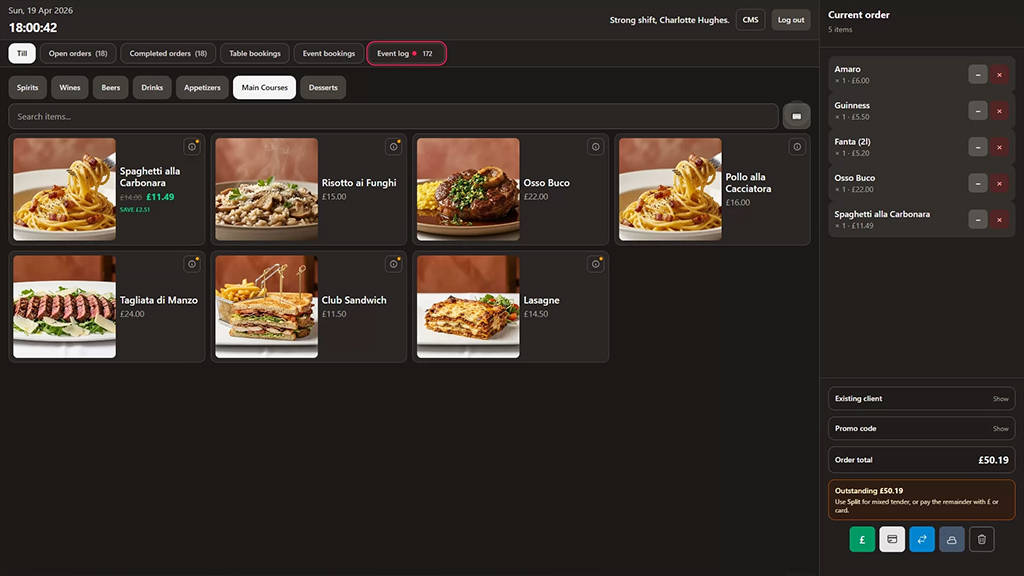
We built our POS around a simpler idea: your sales shouldn’t fund a parallel industry. See the full picture on our restaurant and takeaway ordering system page.
- No per-order POS commission — we do not monetise the till like a tax on every ticket.
- No separate licence fee for the core product — fewer standing monthly drains.
- Runs on the devices you already use — less forced hardware spend.
- Revolut Business — already built in (not a separate “connect your gateway” project). Card acceptance runs on Revolut Business at 0.8%, which we describe as the lowest transaction fees on the UK market for this kind of stack.
- Cash in your account — money lands in Revolut Business without the usual “wait for the payout batch” feeling (exact timing depends on Revolut’s processing rules for your account).
- No extra card terminal required — take contactless on the phone with Revolut’s Tap to Pay, so you are not renting another terminal to sit beside the pass.
Before you switch: confirm Revolut’s live fees (see Revolut’s official Accept payments — pricing & fees page for up-to-date UK rates), device eligibility, and Tap to Pay availability for your handsets. For the full legal fee schedules, Revolut publishes Business fees documentation.
Book a free fit-check
If you want an honest answer on whether this model fits your kitchen, service style, and volume, book a call. We will walk through your current stack, your throughput, and whether our POS + Revolut Business + Tap to Pay is realistic for your restaurant or takeaway — no cost, no obligation.
Sources & further reading
This article distils figures and themes from our deeper research into vendor pricing pages, fee schedules, and hospitality sector statistics. For Revolut Business, use Revolut’s own accept payments pricing and legal business fees pages for current figures. Always verify live vendor pricing before making procurement decisions.